

27/04/26
The Right to Disconnect in Europe: What HR Directors Need to Know in 2026
— Ana Lambert
Managing frontline teams is no longer a matter of goodwill. For HR Directors with staff in several European countries, respecting workers' rest time is becoming a legal obligation with real penalties, and the rules differ from one country to the next.
This article explains where the right to disconnect stands in Europe in 2026, what EU law already requires, and how companies with deskless staff, who have no corporate email and use their own phones, can comply without relying on each manager's discipline.
What is the right to disconnect?
The right to disconnect is a worker's right not to engage in work communication, such as calls, messages or emails, outside working hours, without facing negative consequences. It aims to protect rest time and prevent the stress and burnout linked to an "always on" culture.
Is there an EU law on the right to disconnect?
Not yet. In January 2021, the European Parliament called on the European Commission to propose a directive on the right to disconnect. Negotiations between European social partners did not lead to an agreement, and the Commission launched a second-phase consultation with them in July 2025 on the right to disconnect and fair telework. At the time of writing, no directive has been adopted.
That doesn't mean there are no EU rules. The Working Time Directive (2003/88/EC) already guarantees minimum rest periods, including at least 11 consecutive hours of daily rest. Constant work messages outside working hours make those rest periods hard to guarantee.
Which European countries regulate it?
A growing number of countries have their own rules, with very different approaches:
- France was the first, in 2017: larger companies must negotiate or set rules on the use of digital tools outside working hours.
- Belgium requires private-sector employers above a certain size to set disconnection arrangements.
- Portugal requires employers to refrain from contacting workers during rest time, except in situations of force majeure.
- Ireland has a code of practice that guides how employers should handle the right to disconnect.
- Luxembourg requires companies to put a right-to-disconnect regime in place, and from July 2026 employers that fail to do so face administrative fines.
- Greece, Slovakia, Croatia and Spain have also legislated, and other countries are working on their own rules.
For a company operating in several countries, this patchwork means one policy rarely fits all. The safest approach is a technical setup that respects rest time by default, adapted to the strictest rules that apply to your workforce.
Time recording: an EU-wide requirement
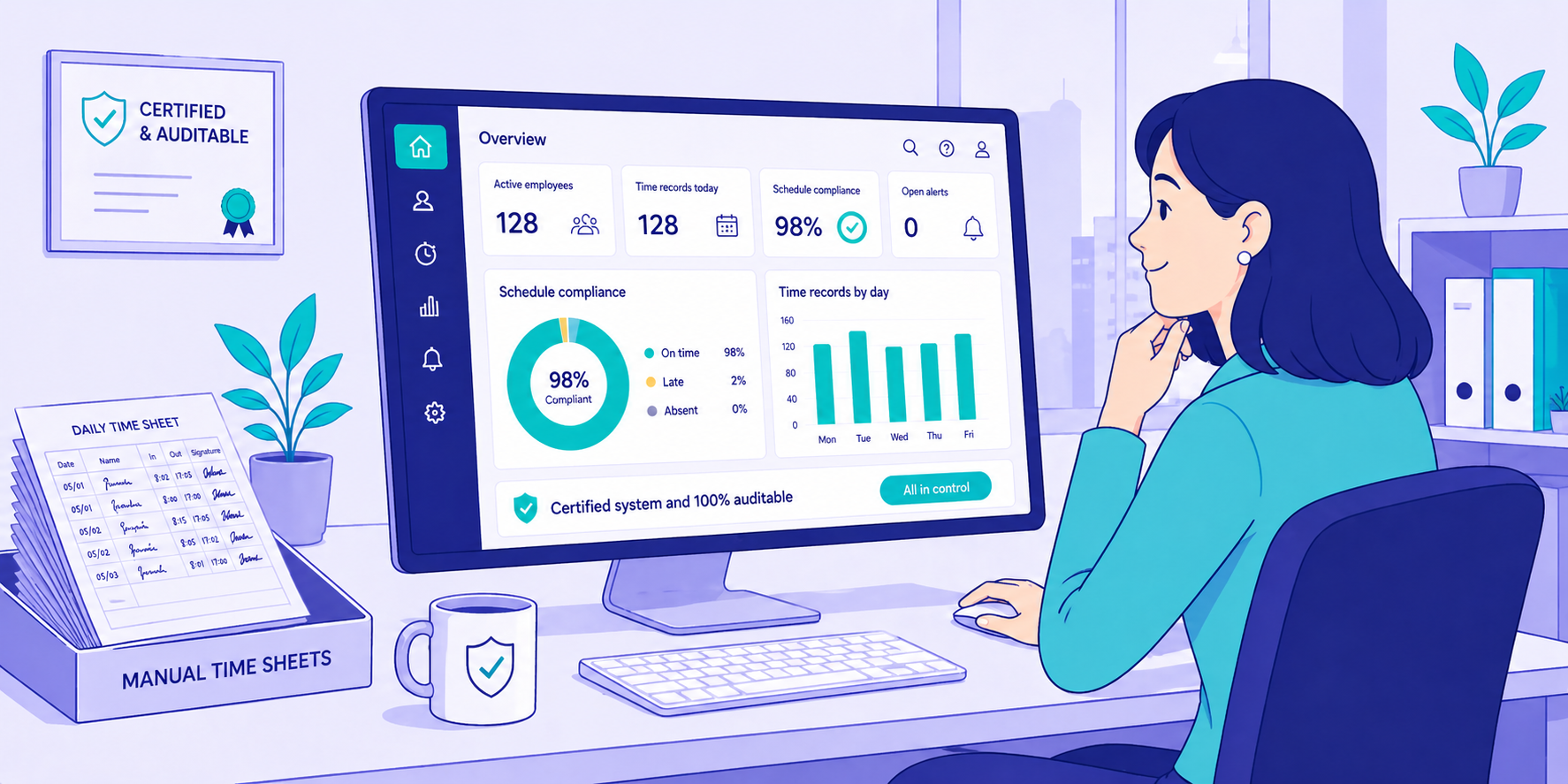
Closely linked to disconnection is working time recording. In 2019, the Court of Justice of the EU ruled that member states must require employers to set up an objective, reliable and accessible system to record each worker's daily working time. Many countries have since strengthened their rules, and inspectors increasingly expect digital records that can't be altered without a trace.
For frontline teams still clocking in on paper or spreadsheets, this is a growing compliance risk.
The danger of WhatsApp with frontline staff
Using personal WhatsApp to coordinate shifts or send payslips is one of HR's biggest vulnerabilities. Work messages arrive on the same app and the same phone employees use with their families, at any hour. It also means using employees' personal phone numbers, which raises its own GDPR issues. We explain them in the GDPR fine you don't see.
What HR teams should do now
- Map your countries: list where you have staff and what each country requires on disconnection and time recording.
- Write a clear policy: define when employees can and cannot be contacted, and what counts as a genuine emergency.
- Involve employee representatives: in several countries, works councils must be consulted or the policy must be negotiated.
- Use technology that enforces it: a policy that depends on each manager remembering not to send messages at night won't hold up.
- Digitize time recording: replace paper and spreadsheets with a reliable digital system.
Ommnio: compliance by design
Ommnio protects both the company and the worker without needing company phones:
- Automated disconnection: each employee sets their schedule in the app, and outside those hours notifications are blocked automatically, so rest time doesn't depend on human error.
- Built-in time recording: a timekeeping bot sends clock-in reminders through the chat. Records are tamper-proof and can be exported as reports when an inspector asks for them.
- Full privacy: work communication happens without anyone knowing the employee's personal phone number, in line with the GDPR.
- Docubot: secure bulk delivery of payslips and certificates to employees' phones, with proof of receipt.
- OmmnioSign: electronic signature of contracts and documents, valid under the EU eIDAS regulation.
For an overview of employers' data protection obligations, read our GDPR guide to employee data privacy for deskless teams.
Conclusion
Being "always on" is no longer just inefficient: in more and more European countries, it is a legal risk. Digitizing your frontline teams with Ommnio protects your company as the rules tighten and turns compliance into a competitive advantage.