

27/04/26
Data Minimization: Why HR Shouldn't Store Employees' Personal Phone Numbers
— Ana Lambert
In people management, there is a rule many HR departments are learning the hard way: the data you don't hold can't get you fined. For decades, the personal phone number has been a standard field in every employee file, as unquestioned as the ID number or the bank account. Under the GDPR, however, this piece of data has turned from an operational convenience into a legal liability.
The data minimisation principle, set out in Article 5(1)(c) of the General Data Protection Regulation, requires personal data to be "adequate, relevant and limited to what is necessary" for the purposes for which it is processed. For an HR Director anywhere in the EU, the question is no longer how to get the phone numbers of frontline workers, but why the company is still storing them.
The personal phone number: a hidden compliance risk
A company does not need an operator's personal phone number to perform the employment contract. It needs a communication channel, which is something quite different. Storing private numbers in the HR system opens the door to three risks:
- Processing without a valid legal basis: using a private number to add a worker to a WhatsApp group or send work notifications goes beyond what the employment contract requires, so the company needs another legal basis to justify it.
- Weak consent: European data protection authorities consider that, because of the imbalance of power between employer and employee, consent at work is rarely freely given. Asking employees to "agree" to share their number seldom solves the problem.
- Leaks and former employees: a database with hundreds or thousands of personal numbers increases exposure in a cyber incident. And when an employee leaves, their number remains in chats and managers' contact lists, a liability the company cannot technically control.
When employees refuse to share their private number
As workers become more aware of their rights, more of them refuse to give their personal number for work communication. In most EU countries, employers cannot force them to, and a refusal should not lead to disciplinary action.
For companies with frontline staff who have no corporate email, this creates an information blackout. If the employee doesn't share their number and the company doesn't provide a work phone, often because the hardware cost is too high, communication breaks down. This is where data minimisation stops being a bureaucratic obligation and becomes a strategic opportunity with platforms such as Ommnio.
Privacy by design: how Ommnio solves it
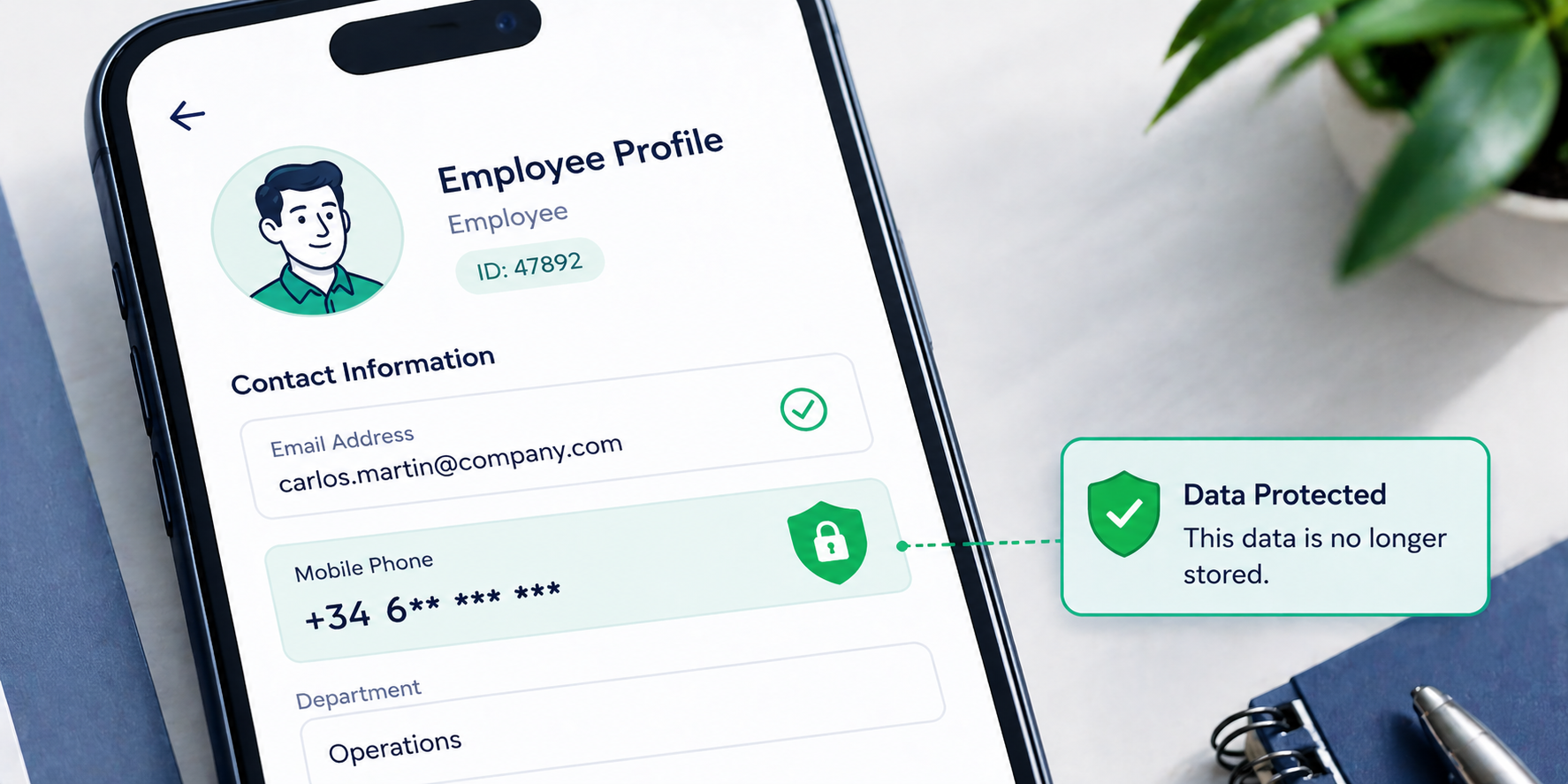
Ommnio is built on the principle of privacy by design, so HR can bring 100% of the workforce onto the platform without knowing, processing or storing their personal phone numbers.
How can you invite someone without their data?
Ommnio lets companies onboard employees through non-intrusive methods:
- Unique QR codes: the employee scans a code at the workplace and registers in the app on their own.
- Invitation links: HR can generate invitations shared through internal systems or email, without the phone number ever reaching the platform administrator.
Once inside the app, the employee's phone number stays hidden. Supervisors and colleagues can message them, coordinate shifts or send documents, but no one in the organization has access to their private data. This removes the possibility of a manager calling or writing through personal channels outside the company's control.
Operational benefits of minimisation
A "zero personal phone numbers" policy doesn't just protect the company legally. It also improves day-to-day operations:
| HR challenge | Risk with WhatsApp or personal channels | Ommnio solution |
| Payslip distribution | Documents sent through channels the company doesn't control. | Docubot: bulk delivery without access to the employee's phone number. |
| Offboarding | No way to revoke access to shared data. | Central account closure: the employee loses access to all content. |
| Right to disconnect | Notifications reach the private phone 24/7. | Alerts are automatically silenced outside the configured schedule. |
| Evidence and audits | Private chats are hard to audit. | Tamper-proof record of read receipts and digital signatures (OmmnioSign). |
Staying protected in front of your data protection authority
Data protection authorities across Europe have fined employers for practices as common as using personal phones for work access codes or running unsecured work groups. Under the GDPR, breaches of the core principles, including data minimisation, can be fined up to 20 million euros or 4% of global annual turnover, whichever is higher.
With Ommnio, HR can show any audit or inspection that the company applies the minimisation principle: it doesn't process personal phone numbers because its communication platform doesn't need them. Compliance is built into the technology, so the HR team no longer has to watch over how every manager behaves on personal channels.
Data minimisation is only one of the GDPR principles that apply to HR. For the full picture, read our GDPR guide to employee data privacy for deskless teams.
Less data, more control
The digital maturity of an HR department is measured by its ability to protect workers' privacy without sacrificing operational speed. The personal phone number should go back to being what it always was: a citizen's private data, not a work tool.
Bringing frontline workers onto Ommnio protects organizations from the legal risks of hyper-connectivity and careless handling of personal data. It's time to simplify your database and professionalize your communication: you gain compliance by no longer needing your employees' numbers.