
.png)
27/04/26
Employee Offboarding: How to Revoke Access to Company Data Immediately
— Ana Lambert
For an HR Manager, offboarding is a moment of real legal and security risk. For frontline, deskless staff, who often have no corporate email or company device, the process tends to be manual and chaotic.
Many team managers believe that pressing "Remove from group" on WhatsApp is enough to protect company information. Under the GDPR, this is a false sense of security that leaves the organization exposed to sanctions and to data leaks it cannot control.
Frontline work needs identity management as rigorous as the one used in offices. Office staff usually lose access to email and internal systems on their last day, while shop floor or service workers often stay for weeks in informal "shadow IT" channels simply because no one removes them.
The illusion of deletion: why WhatsApp doesn't work for offboarding
Using personal WhatsApp for work creates data that the company can never delete. When an administrator removes a former employee from a group, that person stops seeing new messages, but the company has no control over everything shared before.
1. The history stays on the personal phone
Because the app is installed on a private device, the whole conversation history, including rota photos, process files and customer data shared until the last day, remains on the former employee's phone. The company has no right to access that private device to delete the information, which leaves a permanent security gap.
2. Contacts can be exported
In WhatsApp, every group member can see everyone else's phone number. An employee leaving on bad terms can copy or export the contact list of the entire workforce before being removed, and HR cannot undo that afterwards.
3. Cloud backups
WhatsApp backs up chats to personal services such as iCloud or Google Drive. Sensitive company information ends up in private clouds where the organization has no control over security or GDPR compliance.
The legal risk: the end of the legal basis and the right to erasure
Under the GDPR, when an employee leaves, the "performance of the contract" no longer justifies processing their data in active communication channels.
Keeping a former employee in company systems, or letting them keep company data on their personal phone without a justified purpose, conflicts with the storage limitation principle and with the right to erasure (Article 17). The lack of technical measures to secure and delete data after an employee leaves can also breach Article 32, with fines of up to 10 million euros or 2% of global turnover, and up to 20 million euros or 4% when the core principles are infringed.
| Offboarding situation | Risk with WhatsApp | Ommnio solution |
| Chat history | The former employee keeps the entire chat. | Access is revoked and the chat disappears from their phone. |
| Shared files | Photos and PDFs stay in their gallery. | Encrypted documents are no longer accessible. |
| Colleagues' contacts | Phone numbers remain visible forever. | Identities are protected; numbers were never visible. |
| Automation | Manual process, easy to forget. | Automatic removal via API connected to the ERP or HRIS. |
Zombie accounts: the danger of depending on middle managers
In high-turnover sectors such as facility services or catering, communication often depends on groups created by area supervisors. This creates what IT teams call "zombie accounts": former employees who stay in groups because a manager forgot to remove them or because HR doesn't even know the group exists.
These accounts open the door to:
- Rumours and misinformation: former workers taking part in collective bargaining or ongoing labour disputes.
- Leaks of sensitive information: access to new procedures or price changes that only current staff should see.
- Cybersecurity incidents: an unmanaged account is an easy entry point for social engineering attacks.
Ommnio: instant, centralized revocation
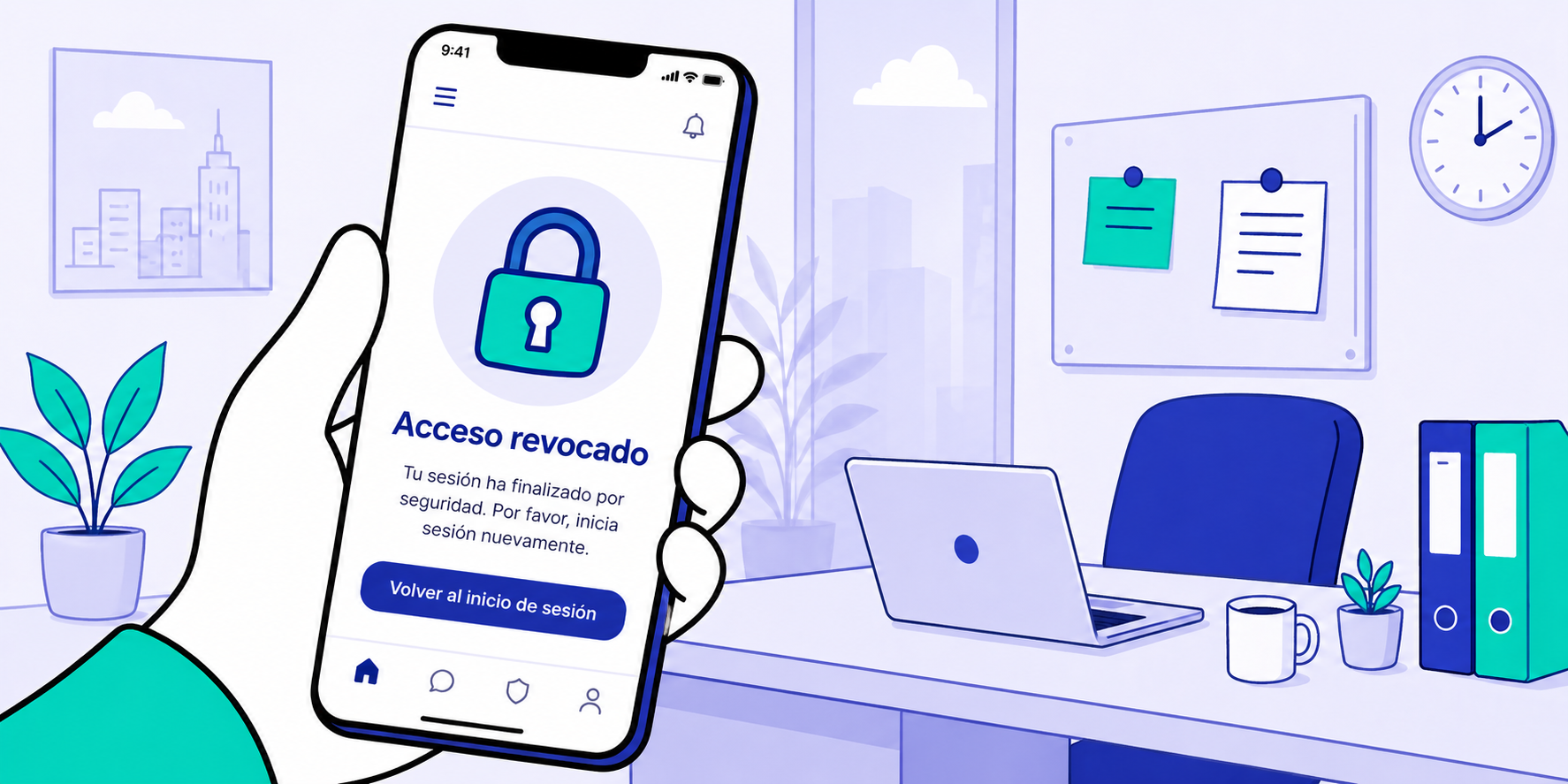
Ommnio solves the offboarding problem for frontline teams with centralized access control. Unlike consumer apps, it puts control back in the hands of HR and IT.
Full automation via API
The most efficient way to manage joiners and leavers is to connect your payroll software or ERP to Ommnio through its API. As soon as an employee is marked as leaving in the company's official system, Ommnio automatically:
- Logs the user out of their personal device.
- Removes their access to all channels.
- Blocks downloading or viewing any document previously sent through Docubot, such as payslips or certificates.
A single control panel for HR
Even without an integration, administrators manage the whole workforce from one central panel. With a single click, an employee is removed from all company channels, without depending on a manager to do it manually in ten different groups.
To understand what else the GDPR requires from employers, read our GDPR guide to employee data privacy for deskless teams.
Professionalizing the digital goodbye
An HR department's digital maturity is measured not only by how it hires, but by how securely it manages exits. Letting company information live on former employees' personal phones is a risk no organization can afford.
Moving from WhatsApp groups to a professional platform like Ommnio turns onboarding and offboarding from a manual headache into an automated, secure and compliant process. It's time to regain control of your data and protect the privacy of those who stay, making sure access to the company ends exactly when the employment relationship does.