
.png)
11/09/26
Only 1% of corporate technology investment reaches essential workers
— Press Release
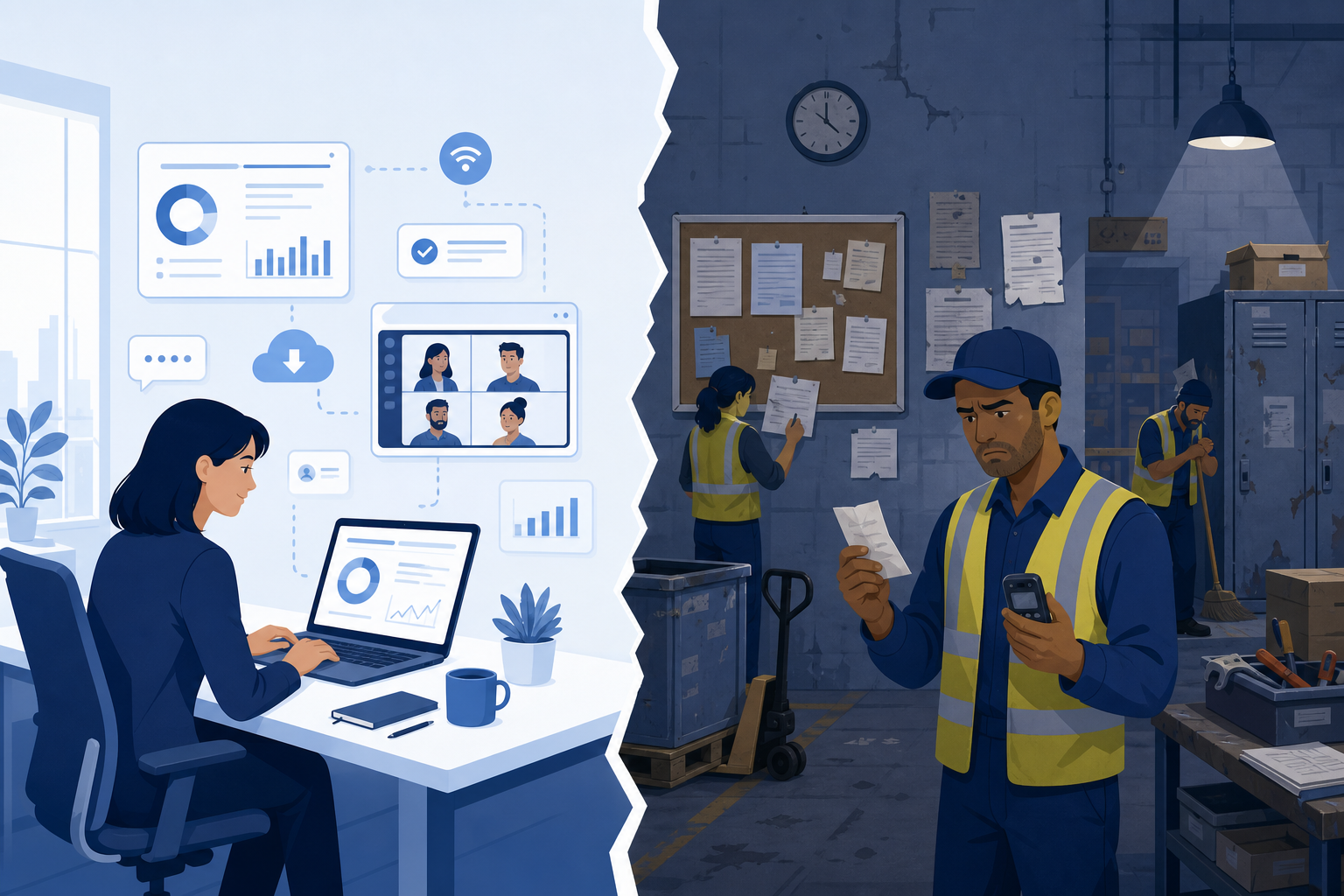
Ommnio highlights the digital divide within organizations and points out that 99% of technology investment continues to be concentrated on office workers, while deskless workers continue to operate under conditions typical of 1994.
Only 1% of corporate technology investment is allocated to front-line, deskless workers, even though this group represents the majority of the workforce in numerous sectors. This is according to Ommnio, a company specializing in the digitization of internal communication in operational environments, which warns of the persistence of a structural digital divide within organizations.
The company emphasizes that, while digital transformation has advanced significantly in office environments, deskless workers continue, in many cases, to operate with tools, processes, and communication dynamics that have not evolved at the same pace.
"We view the pandemic as a missed opportunity for essential employees. Because while they were the ones who kept things running by going to work, technological investment to modernize communications with employees was almost entirely directed toward facilitating remote work for office staff. Years later, many organizations continue to interact with their essential staff via WhatsApp messages, signs in locker rooms, paper notices, and voice calls. Once again, frontline staff have been left out of technology investments."
Uneven Digitalization Within Companies
Deskless workers, those who perform their duties outside an office environment, make up the majority of the global workforce, yet they remain the group least integrated into corporate digitalization strategies.
According to Ommnio, 99% of corporate technology investment continues to be concentrated on office workers, while only 1% is allocated to deskless workers, even though these workers sustain a large part of daily operations in sectors such as manufacturing, logistics, retail, healthcare, and services.
"For years, technological innovation has been designed with the office worker in mind, while the operational reality of most employees has taken a back seat," the company notes.
Fragmented Communication and Reliance on Informal Channels
In the absence of corporate solutions tailored to their reality, many front-line, deskless workers turn to informal channels such as WhatsApp groups to coordinate their daily activities, which leads to fragmented communication within organizations.
This fragmentation makes it difficult to track information, reduces the efficiency of team coordination, and leads to significant differences in the digital experience of employees within the same company.
Furthermore, the lack of specific tools for this group limits organizations' ability to structure their communication and operations in a consistent manner.
Ommnio warns that, even in 2026, many deskless workers continue to interact with their companies in ways more typical of 1994 than of today's digital environment.
"Digital Justice" in the Workplace
The company frames this situation within the concept of "digital justice," which refers to the need to ensure equitable access to technology within organizations, regardless of an employee's role or location.
For Ommnio, digital transformation cannot be considered complete as long as there is a structural gap in access to tools between office workers and deskless workers.
"We don't buy into the notion that front-line employees aren't tech-savvy. Everyone has a cell phone, communicates daily via WhatsApp, books appointments at the hair salon, or authorizes payments through the banking app. If these people can use technology in their daily lives as citizens, they can also use it in their interactions with the company. If they aren't currently using technology to interact with their company, it's because the company hasn't provided it, or because the solution offered to them is designed for office staff."
In this context, the fact that only 1% of technology investment is allocated to this group reflects, according to the company, a persistent imbalance in corporate digitalization priorities.
The Challenge of Completing the Digital Transformation
Beyond the operational impact, the company warns that this technological disparity has direct implications for the efficiency of internal processes, the coordination of distributed teams, and communication across organizational departments.
Ommnio concludes that the next step in the evolution of digital transformation involves fully integrating deskless workers into companies' communication and operational systems, thereby reducing the internal technology gap and moving toward a more balanced model of technology access.