
.png)
27/04/26
What is internal communication in a company, and why is it important?
— Ana Lambert
In today's corporate ecosystem, there is an invisible engine that determines whether an organization moves forward with the precision of a Swiss watch or whether it stops at the slightest obstacle: internal communication. Often mistaken for simply "passing information," internal communication is actually the set of processes, channels and message flows that connect each individual to the company's vision.
For companies with large workforces - especially in sectors such as manufacturing, retail, construction and healthcare - internal communication is not just an HR function; it is a critical operational and legal survival tool.
Defining Internal Communication: Beyond the Bulletin Board
Internal communication is the nervous system of an organization. Its purpose is to ensure that all employees, from top management to front-line staff (deskless workers), understand strategic objectives, feel aligned with the corporate culture and have the information they need to do their jobs efficiently.
Traditionally, companies have relied on static tools:
- Locker room bulletin boards: where information is ignored or becomes obsolete.
- Corporate email: An ineffective solution for the 80% of the global workforce who do not work in front of a desk and lack a professional email account.
- Informal channels (personal WhatsApp): Which generate data security risks, non-compliance with GDPR and violate the right to digital disconnection.
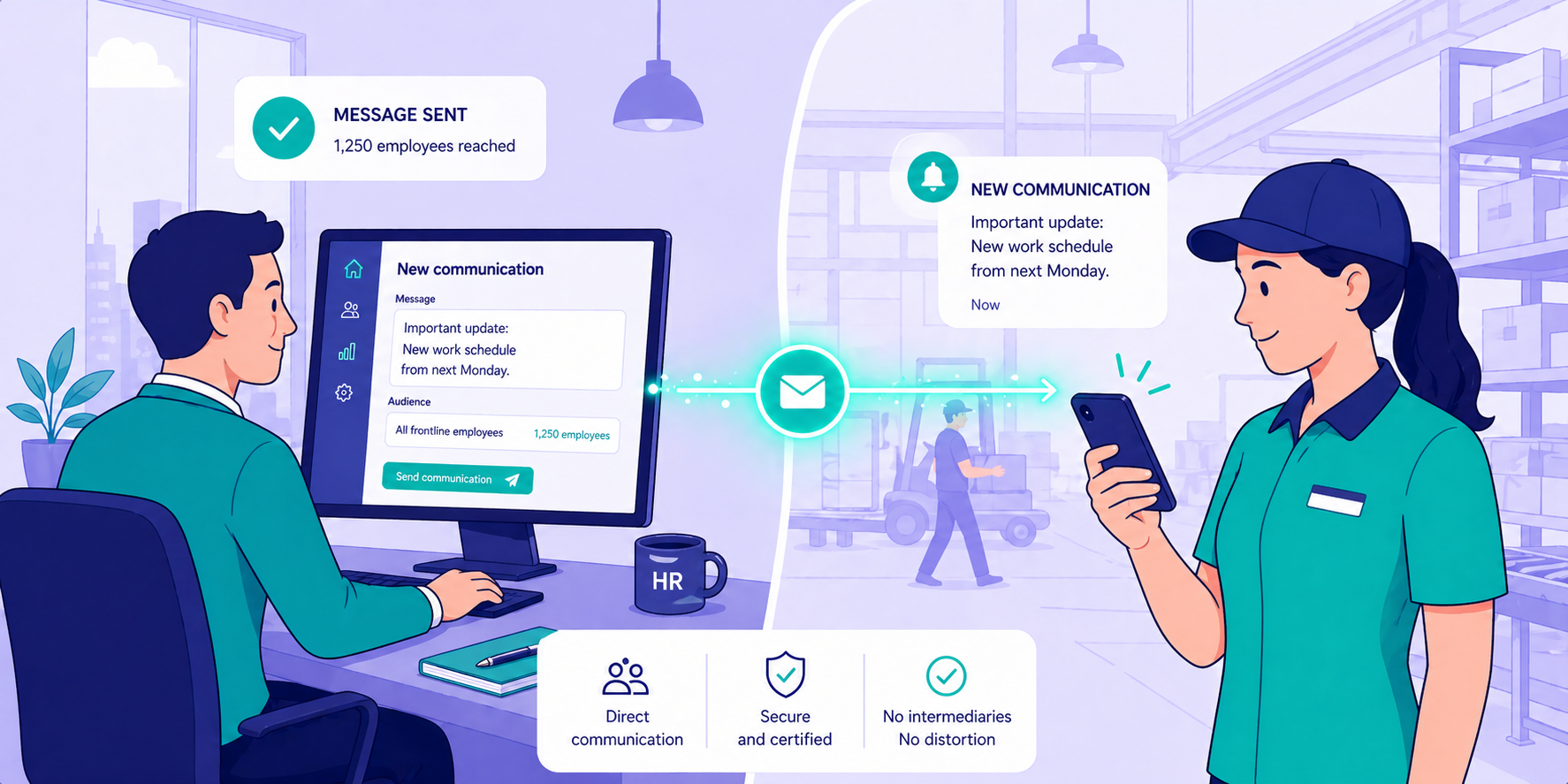
True internal communication in the 21st century seeks to be bidirectional, immediate and secure, eliminating the "broken telephone" that occurs when messages depend exclusively on middle management to reach the base.
Why is internal communication strategic?
The importance of robust internal communication is manifested in four fundamental pillars that have a direct impact on the bottom line:
A. Strategic Alignment and Agility
When management needs to implement a policy change, a new sales campaign or an urgent safety protocol, speed is key.Without a direct channel, the message is diluted or delayed, causing confusion and fragmented execution across teams.Effective internal communication ensures that every employee hears the same message at the same time.
B. Talent Engagement and Retention
An informed employee is an employee who feels valued. Especially in sectors with high turnover, such as hospitality or agriculture, connecting employees to the company's values reduces the feeling of isolation and improves the work climate.
C. Operational Efficiency and Error Reduction
Lack of digitization in communication leads to slow manual processes (shift calls, paper-based signature collection) that increase the risk of human error.Automating the delivery of payroll, certificates or shift coordination through professional instant messaging tools saves HR and Operations departments thousands of hours per year.
D. Legal Security and Reputation
In critical industries such as construction or manufacturing, internal communication is a matter of life and death: instant dissemination of Occupational Risk Prevention (ORP) protocols is mandatory.In addition, having official channels protects the company from reputational and legal risks derived from the use of personal platforms for work-related issues.
The challenge of the "Last Mile": Reaching the worker without a desk
The great challenge of internal communication today is the front-line worker. This profile often lacks corporate hardware and relies on their own cell phone.
For communication to work in these environments, the solution must replicate the user experience they already know: instant messaging. However, unlike apps for personal use, a professional tool like Ommnio introduces critical layers of business control:
- Data protection: Employees connect via QR codes or invitations, without the need to share their personal number with supervisors or peers.
- Right to disconnect: Notifications only arrive during the workday, respecting the employee's rest.
- Traceability: The company can know who has actually read a message or request a digital acknowledgement of receipt for critical documents.
How to implement a successful internal communication plan
Implementing this change is not just about installing a tool, but about transforming the culture. Here are the essential steps:
Phase 1: Audit current channels.
Identify where communication is happening today. Are your managers using WhatsApp groups not controlled by the company?.Are messages getting lost in middle management cascades?.
Phase 2: Defining objectives and JTBD(Jobs To Be Done).
Ask yourself what you need to accomplish:
- "When there is a crisis, I want to inform everyone instantly to protect our reputation".
- "When we send out payroll, I want every worker to receive it securely on their mobile without using paper".
Phase 3: Selecting the right technology
Avoid complex corporate social networks; frontline workers rarely generate content on them.Opt for a platform that centralizes everything: team chat, document management, digital signature and climate surveys.
Phase 4: Launch and Feedback
Use moments of change (mergers, new hires) to activate the tool.It is vital to establish two-way feedback channels, allowing management to receive valuable information directly from the "ground floor".
The future is mobile and human
Internal communication is no longer a top-down flow but a real-time collaborative ecosystem. In a world where attention is the scarcest resource, companies must "be the bridge" to their employees' pockets, facilitating their work life without invading their private sphere.
Digitizing communication with non-desk workers is not just a technological improvement; it is an act of respect for the most important asset of any company: its people. Those organizations that manage to close the gap between the home office and the front line will be the ones that lead the way in productivity and job satisfaction in the next decade.